|
|
Excel
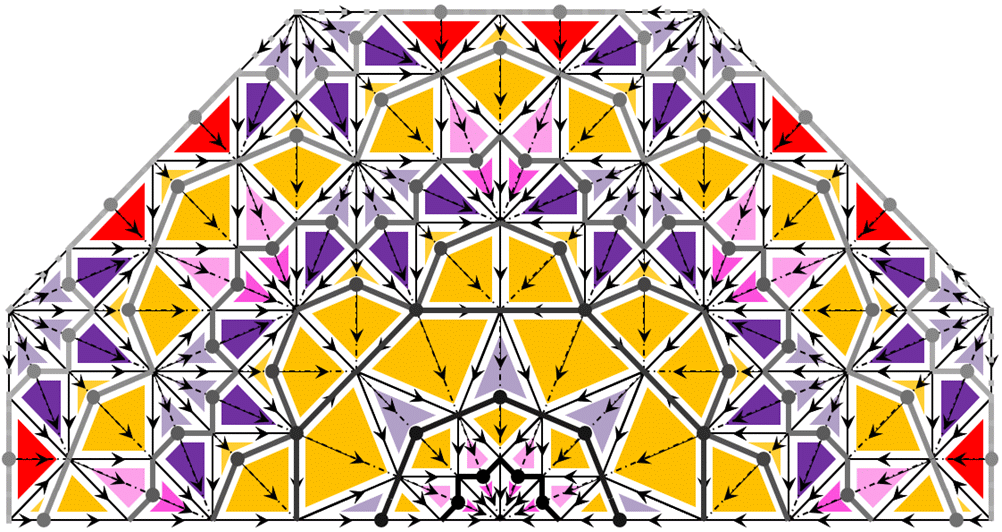
Excel is my development environment to generate and analyze muqarnas floor plans.
The workbook contains:
- a worksheet with parametric definitions of all pre-defined units
- a worksheet for every muqarnas: input specifications, analysis, statistics, interface to GeoGebra, interface to Rhino Grasshopper
- the drawing of a floor plan is in a seperate worksheet
- worksheet with a where-used database
- visual basic modules to interpret and process the input and provide all the output
- a worksheet with parameters for the GeoGebra interface
The interpreter searches through the table for the characteristics of each object specified in the input string.
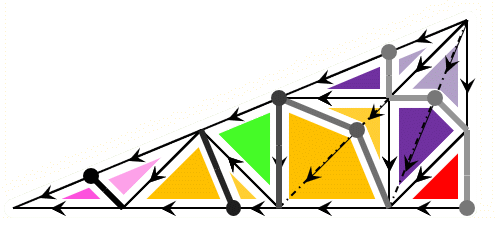
The characteristics of a unit are the angle at the front, the angle at the back, the type (full or intermediate) and the position of the foot column.
My Instagram stories showcase a lot of Excel floor plans.
|
This webpage:
|
Related webpages on this website:
- GeoGebra
GeoGebra is a browserbased app in the cloud. GeoGebra's ability to define and modify macros is a powerful feature. It allows users to record macros and refine them later.
Together with Chris Cambré, I developed a tool that uses buttons to activate macros, each of which draws one of twenty specific muqarnas units. | 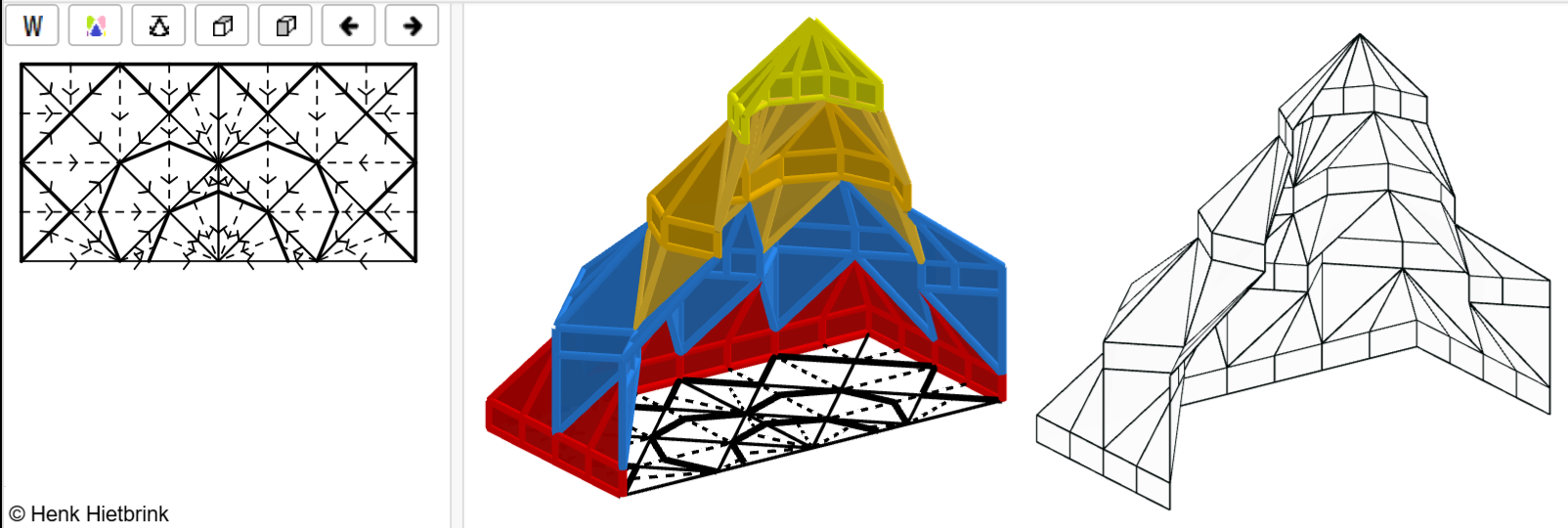 |
- Rhino Grasshopper
Rhino Grasshopper (or Rhino3D) is a commercial 3D computer graphics and computer-aided design (CAD) application. My Grasshopper muqarnas model has four objects, a full unit, an intermediate unit, a flat wall, and a püskül (stalactite). |  |
- STL viewer
ViewSTL offers an online webbased tool that shows the contents of an STL file. This tool supports rotation, panning and zooming. |  |
|
Instagram:
|
Coding Example
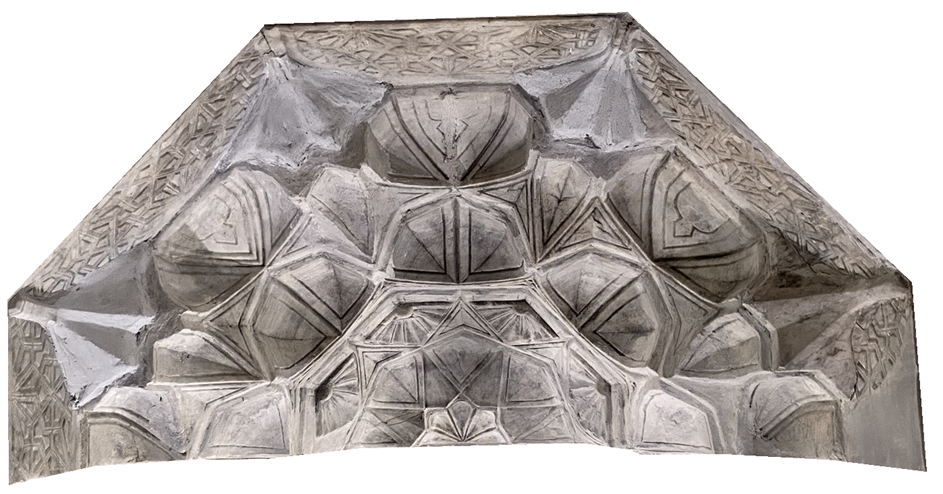
The input of this coding example describes the mihrab muqarnas of Iznik Yesil Cami.
Each line describes a tier, from the top to the bottom, tier after tier.
This design is quite common, especially the upper part of the muqarnas is quite standard for octagonal plans.
|
|
In the top tier, there are four occurences of type M.
|
|
|
|
The second tier from top has two different units D and N,
alternating four times, starting and ending with half a D.
Together, the N and M are a rhombus. There are four occurences.
|
|
|
|
The third tier from top has two different units B and J,
alternating four times, starting and ending with half a J at the side of the muqarnas.
Together, the J and D are a square.
|
|
|
|
The fourth tier has only unit D.
Note that a full unit B is stacked on top of the sides of a full unit D.
|
|
|
|
|
The fifth tier has three different units E, C, and J.
Together, the J and D are a square.
|
|
|
|
The bottom tier has only unit I
Together, the I and C are a rhombus
|
|
|
|
|
Language
An interpreter requires a well-defined syntax; an unambiguous language capable of handling exceptions.
In the case of muqarnas, symmetry often plays a key role, whether through reflection or repetition.
This means that instead of specifying an entire muqarnas structure, only a relevant portion needs to be described.
My interpreter accommodates symmetry by completing partial descriptions.
It recognizes references to the left or right side of a unit, such as D1 and D2, and can join these halves into a complete unit.
Additionally, it accounts for variations in dimensions, including the reductions or enlargements seen in the muqarnas of the Diyarbakır Kasim Padisah Last Congregation.
Simple muqarnas can be described by just the letters.
Exceptions arise in certain cases, such as the muqarnas of Mardin Sultan Isa Medrese, Diyarbakır Kasim Padisah, and Bursa Timurtas (see *Tiers, Aim, Tuncer*).
When complexity grows, detailed instructions tell the interpreter how to cope with these exceptions.
To support the development process, a built-in debugger enables step-by-step drawing, ensuring that the interpreter correctly understands my language.
Here are two examples. The top one specifies a quarter, the bottom one specifies an eight part of the whole muqarnas.
|
|
|
|
|
Exception Example
The Last Congregation Mihrab of Kasim Padisah in Diyarbakır has an interesting top.
One tier has larger units and another has much smaller dimensions.
It is three times a D, but the interpretor needs to know the enlargement or reduction factor.
These factors can be computed with some algebra and become square roots of square roots.
|
Parametric Design
Microsoft Visual Basic can support parametric design, allowing for flexibility in defining unit dimensions. Instead of being hardcoded, the unit dimensions and characteristics are stored in a worksheet containing part definitions.


Excel Unit Definitions
Output
Excel generates all kind of outputs in the muqarnas worksheet:
- a full descriptio taking into account all symmetries and exploding user-defined building blocks
- a description without technical details for comparison purposes
- entropy calculations (an idea of Orkan Zeynel Güzelci and Sema Alaçam)
- frequency tables (occurences, horizontal neighbours, vertical neighbours)
- warnings and error messages
- where-used-list
- interfaces to GeoGebra and Rhino/Grasshopper
- log file with the latest muqarnas description (in case you want to return to a previous description)
|
|