|
|
GeoGebra
GeoGebra is a browserbased app in the cloud. In the old days, teachers like me installed it on their devices, but now students can do geometry and algebra in the mathematics class on any device and share their work with teachers and friends.
|
This webpage:
|
Related webpages on this website:
|
|
Macros
GeoGebra's ability to define and modify macros is a powerful feature.
It allows users to record macros and refine them later.
Together with Chris Cambré, I developed a tool that uses buttons to activate macros, each of which draws one of twenty specific muqarnas units. The process is straightforward: click the button corresponding to the desired shape, select the placement point, and GeoGebra automatically adds the unit. These points can either be part of previously placed units or explicitly added to the grid by a macro.
The intended workflow starts with constructing a 2D floor plan. Once the layout is complete, the muqarnas can be built in GeoGebra's 3D panel using a similar button-driven approach.
One of GeoGebra's features is its ability to export STL files, making it easy to prepare designs for 3D printing. This allows for physical prototyping and hands-on exploration of muqarnas structures.
Or to view the muqarnas in a web browser via www.viewstl.com.


GeoGebra Macro Buttons
Interface from Excel to GeoGebra
Creating large muqarnas in GeoGebra can involve a lot of manual clicking.
In contrast, my Excel-based approach required specifying only a fraction of the design to be specified, using symmetry, typically only a quarter or an eighth of the muqarnas.
In GeoGebra, however, each unit had to be placed individually, making the process time-consuming.
The solution was to code an interface between my Excel application and GeoGebra.
Now, I can describe the muqarnas in Excel, import the output into GeoGebra, and instantly visualize the 3D model which is ready for 3D printing.
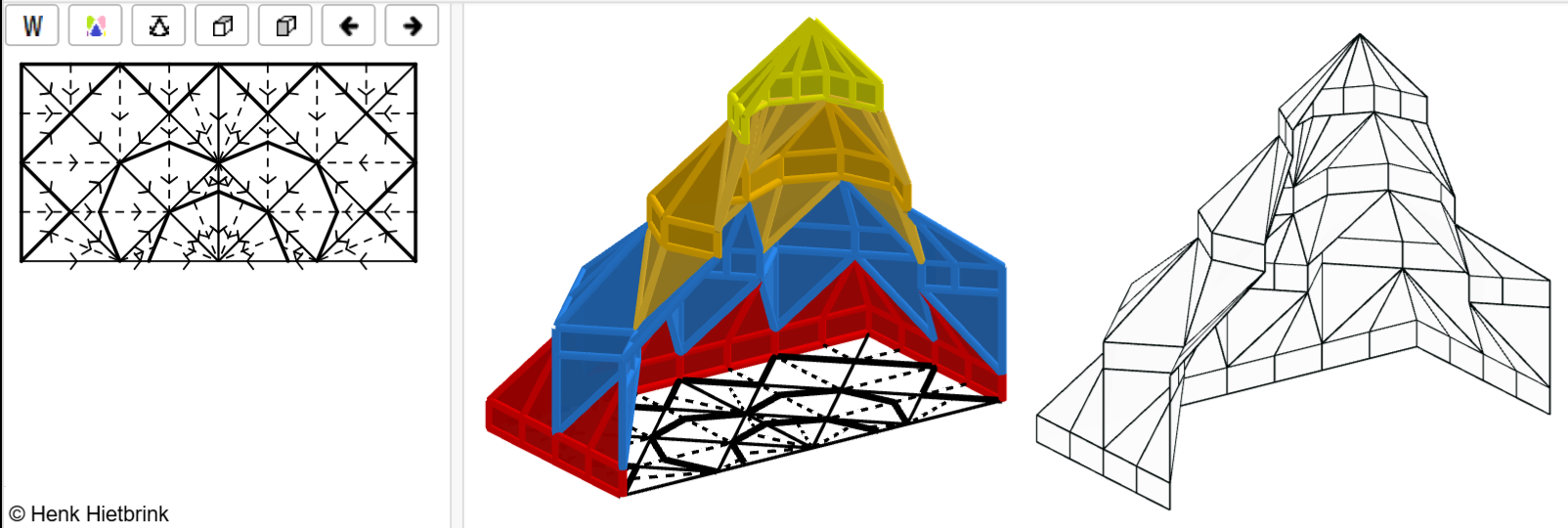
GeoGebra Muqarnas Viewer
Disadvantages of GeoGebra
Creating muqarnas in GeoGebra was a big step forward, but not the end of the road.
The shapes are made from planes and lack the typical smooth curves that make muqarnas so beautiful.
Rhino Grasshopper can do much better.
Although we started with Harmsen's twelve units and implemented eight units more, the actual number of different units was expanding to more than thirty.
We only had buttons for complete units, and lacked the opportunity of adding half units.
The interface from Excel to GeoGebra was a fat one. The Excel script had to generate all the points, line segments, and polygons and write them down in the GeoGebra XML specification.
My GeoGebra viewer has buttons to view the 3D muqarnas tier by tier, with or without the floor plan.
The necessary code became part of the interface. So, I had to put all GeoGebra stuff in the Excel script.
Switching to Rhino Grasshopper was a logical step.
Geogebra Books
Henk Hietbrink published a GeoGebra book on muqarnas with a tool to create muqarnas in the GeoGebra cloud.
Chris Cambré has published many GeoGebra books. Islamic geometric patterns are one of his areas of interest.
Turkish Examples in GeoGebra
Examples of Turkish muqarnas have been published in a GeoGebra book.
- Starter work pieces
Young students start with an easy assignment where the rules are quickly discovered. This two-layer muqarnas follows the rule "back on front". Students were handed over a construction plate for a quick start. |  |
- Student work pieces
At the NVvW 2019 study day, three helpful children asked if I may need their help. I was curious how far they would come with a minimal explanation. Within half an hour, they assembled their muqarnas from 3D printed units. |  |
- Bursa Abdal Mehmet Camii
In Bursa, you will find the Abdal Mehmet mosque. This muqarnas follows the rule "back on curve". |  |
- Nigde Ak Medresse
The mosque Ak Medresse is situated in Nigde. The Turkish architect M. Fatin Uluengin has written a valuable book about muqarnas. My reconstruction may have been done according to the rules, namely "back on front", the result looks weird and does not match the photo. The first layer is much too wide. Moreover, the photo shows five layers and the reconstruction only four layers. After implementing the additional rule "back on curve", the missing layer becomes visible. Instead of the blue "intermediate units" there will be muqarnas units with a wall. The result is a slimmer and higher muqarnas that matches both Uluengin's analysis and the photo. Below, the five-layer reconstruction is shown which is based on the rule "back on curve". |  |
- Ermenek Tol Medresse
In Ermenek, you will find the Tol Medresse. This muqarnas follows the rule "back on curve". Ödekan classified this muqarnas as type 2A. Its module consists of three concentric circles. My Instagram posts tells you more. |  |
|
- Prof. Dr. Uluengin
Prof. Dr. Fatin Uluengin wrote an impressive book on mukarnas (muqarnas) in Turkish with a lot of drawings and design information. |  |
- Natanz
Natanz is a city between Teheran, Kashan and Isfahan with a beautiful great mosque. Yaghan and Harmsen described an example of a muqarnas in a niche, which is situated in the basement vault of the north iwan in that mosque (Masjid-i Jami). |  |
- Kayseri Cifte Madrasah Gevher Nesibe
Above a door of the Cifte Madrasah Gevher Nesibe hospital, a muqarnas with a special set of two non-standard building units has been realized. The set creates space within the square surface of the underlying layer for a smaller building unit on the next layer. As a result, the surface of a standard square is doubled in height. |  |
- Çorum
In the province of Çorum in the city of Osmancik there is a mosque with an interesting muqarnas. This muqarnas follows the line "back on front". The muqarnas can be built from the standard basic units, with a few exceptions. Half of a standard intermediate unit is required on the first building layer. In the second, half of a unit is needed. In the third building layer half of a standard intermediate unit is also needed. |  |
- Amasya
The Bimarhane mosque is located in Amasya. In the entrance portal, two small muqarnas are incorporated in the wall on the left and right. This muqarnas follows the line " back on front " and has as exception only two half intermediate units. That is why the assembly of this muqarnas is a clear assignment for young students. |  |
- Golpayegan
The Friday Mosque of Gulpayigan was built by Seljuk Sultan Muhammad Tapar I (1105-1118), son of Malik Shah I. Only the dome chamber remains from the Seljuk period mosque, which was integrated into a monumental four-iwan mosque during the Qajar period. |  |
- Marmara University Theology Faculty Mosque
Marmara University Theology Faculty Mosque has been built in 2012 in Üskudar, Istanbul. The mihrab has a classical Ottoman style muqarnas of six layers. The layer under the top hides a surprise. The muqarnas has a unique transition from the star in the top to the rectangle in the layer below. The two soft purple intermediate parts next to the blue parts at the end are very special., the two light pink parts in the middle too. These unique parts enables a quick transition from the star shape to the rectangle. |  |
|
Armenian Examples in GeoGebra
Mamoun Sakkal wrote a thesis on muqarnas ans a supplement on Armenian muqarnas.
Visualizations are made available in a GeoGebra book.

GeoGebra Book: Armenian Examples
|
|
Detailed information
More detailed information about the basic asignment, including pictures and samples of 3D models, is available at a seperate webpage.
|
Student Basic Assignment
At the NVvW 2019 study day, three helpful children asked if I may need their help.
I was curious how far they would come with a minimal explanation.
Within half an hour, they assembled their muqarnas from 3D printed units.
 all the details and a full screen animation all the details and a full screen animation
Easy Starter Activity
Young students start with an easy assignment where the rules are quickly discovered.
This two-layer muqarnas follows the rule "back on front".
Students were handed over a construction plate for a quick start.
all the details and a full screen animation
|
Art-S-Cool 2021
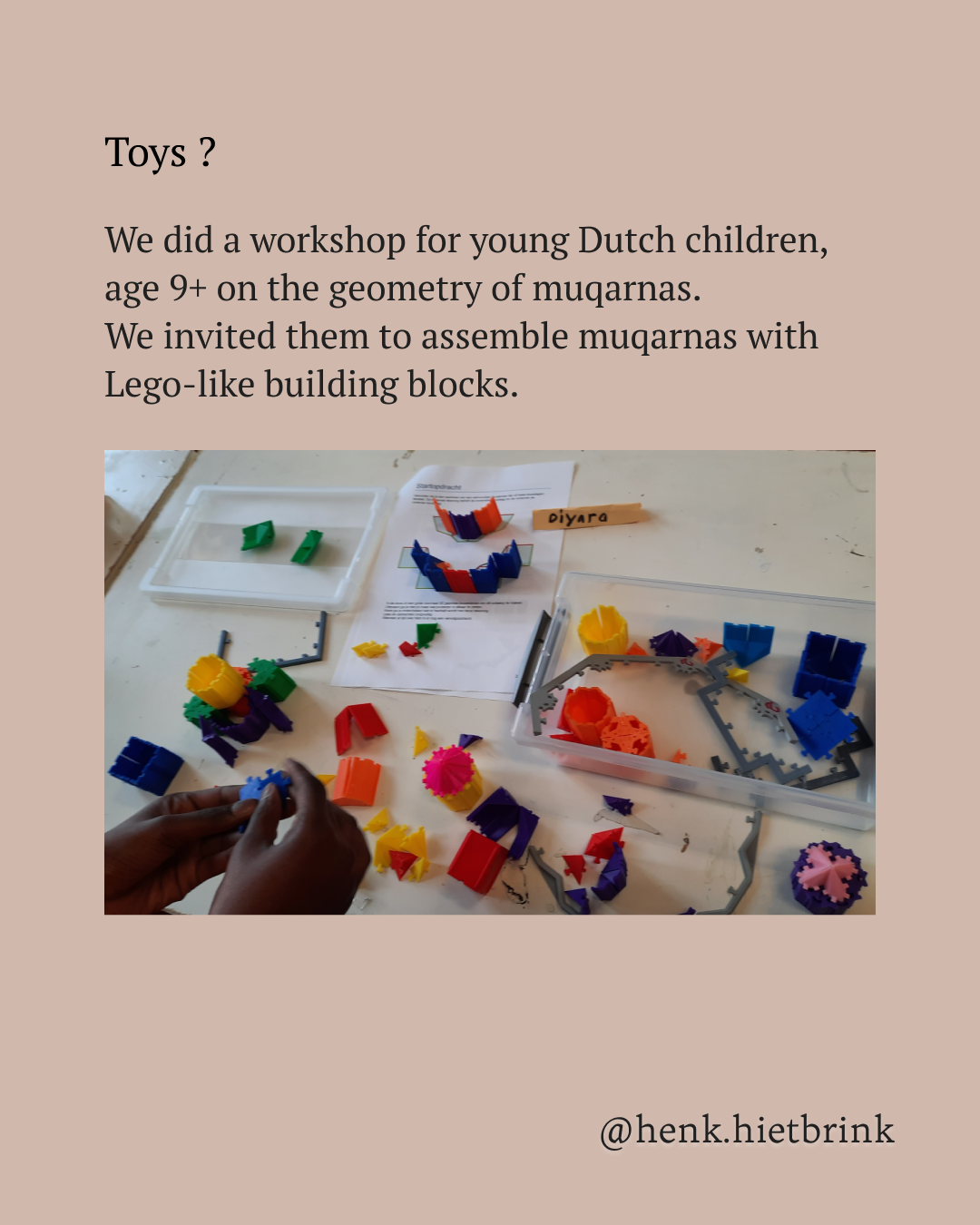
We did a workshop for young Dutch children, age 9+ on the geometry of muqarnas.
We invited them to assemble muqarnas with Lego-like building blocks.
|
|
|
M. Fatin Uluengin

all the details and a full screen animation
|
|
Ermenek
Ermenek is a small town in Karaman Province in the Mediterranean region of Turkey.
Detailed information
More detailed information on this Ermenek Tol Medresse muqarnas, including pictures and samples of 3D printed models, is available at a seperate webpage.
|
Ermenek Tol Medresse
In Ermenek, you will find the Tol Medresse.
This muqarnas follows the rule "back on curve".
Ödekan classified this muqarnas as type 2A. Its module consists of three concentric circles.
My Instagram posts tells you more.
|
YouTube Video

|
Bursa
Bursa is the fourth most populous city in Turkey with large industries. In the fourteenth century, it was the capital of the Ottoman State.
Bursa has a modern Science Center. Every year, they organize the Turkish Airlines Science Expo, a four day experience with more than hundredthousand visitors.
Mountain Uldağ is a lovely place, in winter there are ski resort, in summer it hosts the Bursa AstroFest.
Detailed information
More detailed information on this Bursa muqarnas, including pictures and samples of 3D printed models, is available at a seperate webpage.
|
Bursa Abdal Mehmet Camii
In Bursa, you will find the Abdal Mehmet mosque.
This muqarnas follows the rule "back on curve".
all the details and a full screen animation
|
ArchNet
Description from ArchNet: The mosque that bears the name of celebrated mystic Abdal Mehmed in Bursa was founded by Basçi Ibrahim, a rich merchant of Bursa who also built the Basçi Ibrahim Complex.
|
Nigde
Nigde is a small city with some tourist attractions including an archeology museum
and the Alaaddin mosque with its beautiful muqarnas.

Detailed information
More detailed information about the Nigde muqarnas, including pictures and samples of 3D printed models, is available at a seperate webpage.
|
Nigde Ak Medresse
The mosque Ak Medresse is situated in Nigde.
The Turkish architect M. Fatin Uluengin has written a valuable book about muqarnas.
My reconstruction may have been done according to the rules, namely "back on front", the result looks weird and does not match the photo.
The first layer is much too wide.
Moreover, the photo shows five layers and the reconstruction only four layers.
After implementing the additional rule "back on curve", the missing layer becomes visible.
Instead of the blue "intermediate units" there will be muqarnas units with a wall.
The result is a slimmer and higher muqarnas that matches both Uluengin's analysis and the photo.
Below, the five-layer reconstruction is shown which is based on the rule "back on curve".
all the details and a full screen animation
|
ArchNet
Description from ArchNet:
Ak Madrasa, whose architect is unknown, was commissioned by Ali Bey under Karamanid rule in south-central Anatolia. It is a double storey building with a flat roof, centered on an open courtyard, and with a symmetrical plan aligned north south, measuring approximately twenty-two meters by twenty-five meters.
The entrance, which is reached by descending twelve steps form the street level, is through the muqarnas pishtaq on the north façade. The building's name, which means White Madrasa, refers to this white marble pishtaq. A vaulted passageway leads into the courtyard through the portico. The courtyard has a well at its center and measures about eight and a half by nine and a half meters. It is framed by the main iwan on the south and wrapped by a double-story portico on the other three sides.
|
Natanz
Natanz is a small city with a long history. Its monuments deserve a visit.
Detailed information
More detailed information about the Natanz muqarnas, including pictures and samples, is available at a seperate webpage.
|
Natanz
Natanz is a city between Teheran, Kashan and Isfahan with a beautiful great mosque.
Yaghan and Harmsen described an example of a muqarnas in a niche, which is situated in the basement vault of the north iwan in that mosque (Masjid-i Jami).
Blair has written in detail about the shrine complex of Natanz.
Harmsen investigated a muqarnas in a niche into great extent. She made a replica of carton. Interesting is what happens at the third layer. She did fill in the gap in the paper version, but not in her computer models. Her rules to generate and interpretet graphs do not help her to solve what she omits: sometimes, you need flat walls. As a result, the software does not understand how to connect tiers, especially the rhombus at the first and second layer. In my interpretation, I added flat walls and a new non-standard muqarnas unit: a half square with a wall at the short side (instead of its wall on the long side.
Yaghan also studied this muqarnas. His drawings are very precise, but do not tell which object is drawn. In my analysis, I labeled every unit. Four units could not be recognized. My assumption is a combination of flat walls and a non-standardhalf square. Questions arise about the need of drawing the the short diagonals of the rhombus and the meaning of the large rectangle. His analysis drawing is almost identical to Harmsen, but there are differences, small in detail, but major impact on the interpretation. That is why I developed the paper 2D analysis, bought a 3D printer, started printing 3D objects and developed dedicated software to find out whether these differences matter.
Blair, S., The Ilkhanid Shrine Complex at Natanz, Iran, Cambridge Harvard University Press, 1987
Blair, S., Bloom, J.M, The Art And Architecture Of Islam (1250- 1800), New York, Yale University Press, 1994
Harmsen, S., Algorithmic Computer Reconstructions of Stalactite Vaults - Muqarnas - in Islamic Architecture, 2006, PhD thesis
Yaghan, M., Decoding the Two-Dimensional Pattern Found at Takht-i Sulayman into Three-Dimensional Muqarnas Forms, Iran, Vol. 38 (2000), pp. 77-95

all the details and a full screen animation
|
ArchNet
Description from ArchNet: The Great Mosque of Natanz is located on a site occupied since the Buyid period (tenth century).
In the fourteenth century it took the form it does today.
Today the mosque complex contains a four-iwan mosque, an octagonal sanctuary, a minaret, and a mosque from the 1930s fronted by a fourteenth-century khanqah portal.
|
Kayseri
Kayseri is a city with sturdy Byzantine city walls and Ottoman mosques decorated with attractive muqarnas.
Detailed information
More detailed information about the Kayseri muqarnas, including pictures and examples, is available at a seperate webpage.
|
Kayseri Cifte Madrasah Gevher Nesibe
Above a door of the Cifte Madrasah Gevher Nesibe hospital, a muqarnas with a special set of two non-standard building units has been realized.
The set creates space within the square surface of the underlying layer for a smaller building unit on the next layer.
As a result, the surface of a standard square is doubled in height.

all the details and a full screen animation
Harmsen and Krömker describe this extraordinary unit because their software did not recognize its geometry.
|
ArchNet
Description from ArchNet: The Çifte Madrasa is so named because it consists of two adjacent four-iwan buildings oriented north-south. The one to the east was founded as a medical school by Sultan Giyaseddin Keyh&uul;srev (1192-1197 and 1205-1211) and the other was founded as a hospital by his sister Gevher Nesibe Sultan. The complex is not only the first Seljuk madrasa in Kayseri, but also the oldest hospital in Anatolia.
|
Çorum - Osmancık
In the Turkish district Çorum you will find the city of Osmancık.
Detailed information
More detailed information about the Çorum - Osmancık muqarnas, including pictures, 3D models and examples, is available at a seperate webpage.
|
Çorum
In the province of Çorum in the city of Osmancık there is a mosque with an interesting muqarnas.
This muqarnas follows the line "back on front".
The muqarnas can be built from the standard basic units, with a few exceptions.
Half of a standard intermediate unit is required on the first building layer.
In the second, half of a unit is needed.
In the third building layer half of a standard intermediate unit is also needed.
Shiro Takahashi's drawing suggests some unique units in the top layer.
This muqarnas needs further study at this point.
The assignment for students is slightly different and solely based on standard building units.

all the details and a full screen animation
|
|
Amasya
Amasya is an ancient city with a long history that starts before the Roman times.
It was also an important city in Ottoman times. Sultan Selim I was born there, for example.
Detailed information
More detailed information about the Amasya muqarnas, including pictures and 3D printed models, is available at a seperate webpage.
|
Amasya / Bimarhane
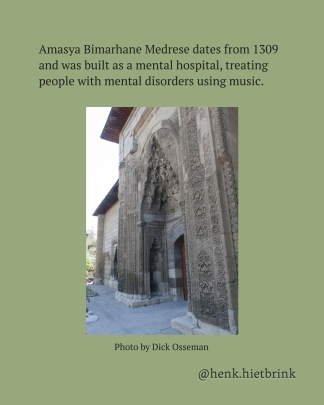
The Bimarhane mosque is located in Amasya.
In the entrance portal, two small muqarnas are incorporated in the wall on the left and right.
This muqarnas follows the line " back on front " and has as exception only two half intermediate units.
That is why the assembly of this muqarnas is a clear assignment for young students.

all the details and a full screen animation
|
Instagram
Two of my Instagram posts deal with the Bimarhane of Amasya.
ArchNet
Description from ArchNet: The Bimarhane of Amasya is dated to the year 1308.
Today the Amasya Bimarhane is a museum dedicated to the history of medicine and surgery named after Sereffudin Sabuncuoglu who was a surgeon and physician active in Amasya during the Ottoman period.
The building is entered through an ornate portal on its west side. This portal consists of an arched doorway within a shallow iwan surmounted by a muqarnas hood and framed with bands of vegetal and geometric ornament carved in stone. Within the recessed entryway are two smaller muqarnas niches surmounted by inscription bands.
|
|
|
Marmara University Theology Faculty Mosque
Marmara University Theology Faculty Mosque has been built in 2012 in Üskudar, Istanbul.
The mihrab has a classical Ottoman style muqarnas of six layers.
The layer under the top hides a surprise.
The muqarnas has a unique transition from the star in the top to the rectangle in the layer below.
The two soft purple intermediate parts next to the blue parts at the end are very special., the two light pink parts in the middle too.
These unique parts enables a quick transition from the star shape to the rectangle.


|
Instagram
One of my Instagram posts deals with the Istanbul Uskudar Marmara University Theology Faculty .

|
Golpayegan

Detailed information
More detailed information about the Golpayegan muqarnas is available at a seperate webpage.
Ali Reza Sarvdalir

|
Golpayegan
all the details and a full screen animation
|
ArchNet
Description from ArchNet: The Friday Mosque of Gulpayigan was built by Seljuk Sultan Muhammad Tapar I (1105-1118), son of Malik Shah I.
Only the dome chamber remains from the Seljuk period mosque, which was integrated into a monumental four-iwan mosque during the Qajar period.
The square dome chamber, or sanctuary, is constructed entirely of brick and is opened on three sides with vaulted archways flanked by embedded columns. The east and north corners of the chamber have thick double columns marking the corner, flanked by narrow archways cut into the adjoining walls that are topped by arched windows. Only a single such archway exists at the western corner and there are none at the southern corner. Above, the transition to the shallow brick dome is achieved with muqarnas squinches built into the corners of the tall octagonal drum. Light comes in through four honeycomb windows pierced into the dome's base, which is ringed with a band of Kufic inscriptions.
|


