al-Kashi and his followersSenalp offers a definition: "The muqarnas is a vaulting system based on the replication of units arranged in tiers, each of which supports another one corbeled on top of it." Some emphasise the suspended nature, for example the rope-hung plasterwork in a wooden frame (Isfahan) or the hanging stalactite-like forms (Istanbul). Others highlight the stacked hewn stone that builds upward. In all cases, the regularity, symmetry, repetition, and layering stand out with the star at the apex, the origin point of the entire design. For centuries, mathematicians have been intrigued by muqarnas. Their story traces back to the 15th-century Iranian mathematician and astronomer al-Kashi, who computed the area of curved surfaces. Today, mathematicians dream of algorithms that can lift a two-dimensional tessellation into a coherent three-dimensional muqarnas form. It turns out that this kind of reverse engineering is as promising as it is disappointing.
|


al-Kashi
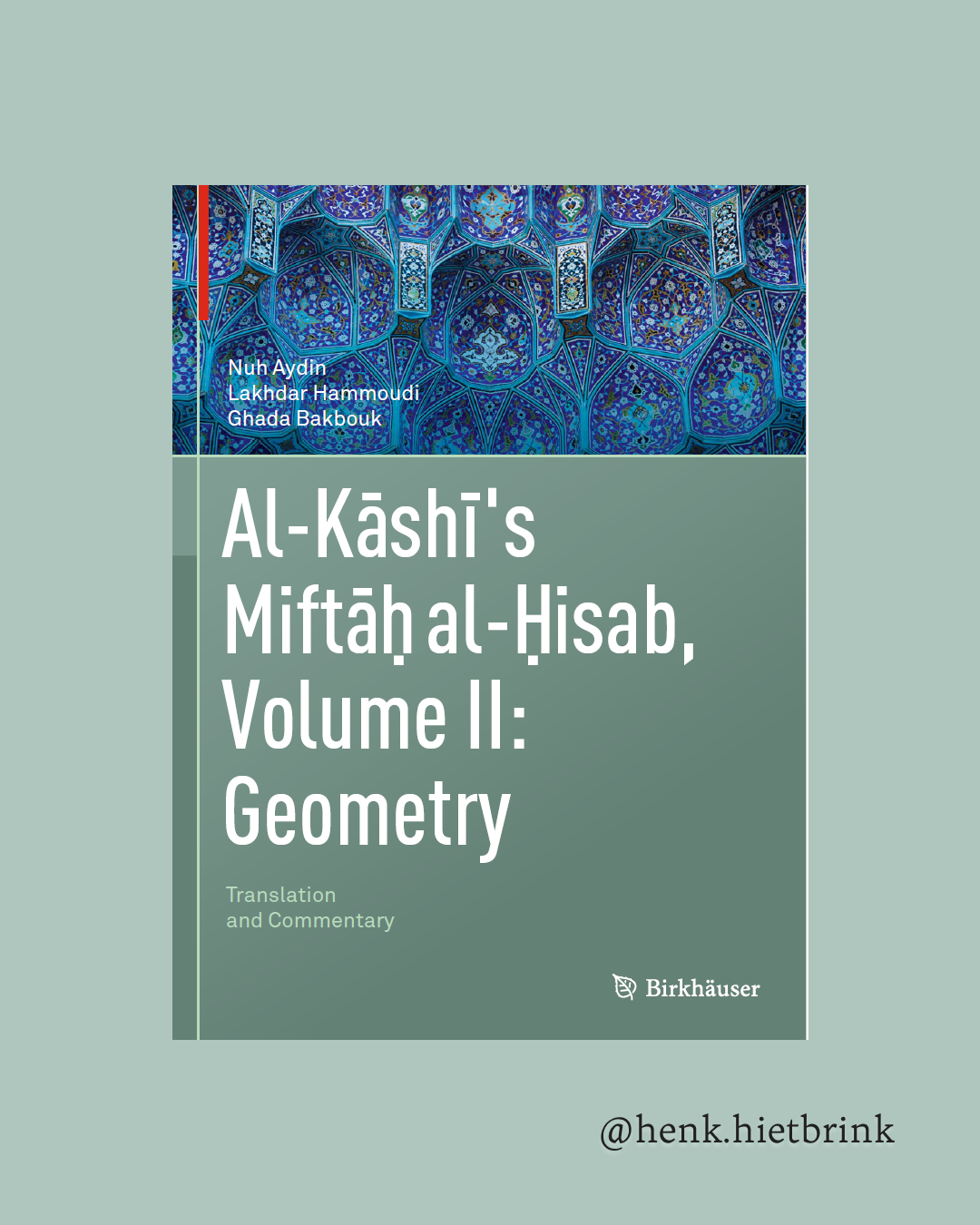
Ghiyath al-Din Jamshid b. Mas'ud b. Mahmud Kashani, better known in Western literature as al-Kashi, was a prominent Iranian mathematician and astronomer of the medieval Islamic world. He was born in Kashan, where he was engaged in astronomical observations before his departure for Samarkand in 1421 He died in 1429. Al-Kashi joined the scientific circle of Ulugh Beg, the ruler of Samarkand. Several handwritings are extant today. One of them is Miftah al-hisab (Key to arithmetic), which includes a chapter on arches and muqarnas. Three authors worked together on a translation and commentary of this work: Nuh Aydin, Lakhdar Hammoudi, and Ghada Bakbouk. Of interest is volume II: Geometry
According to his book, al-Kashi discussed muqarnas design with craftsman. He wrote that a muqarnas composition is divided into tiers (tabaqa) that in turn are divided into units {bayt). He also enumerated the different types of muqarnas vaults: the plain or simple (sadhijj), claycovered (mutayyan), arch (qaws), and Shirazi (shirazi). The sadhijj is the simplest of the four and is characterized by angular elevational outlines; the mutayyan is similar to the sadhijj except that its tiers are not all of the same height; and the qaws has curving elevational outlines. The Shirazi is the most complex of the four. Unlike the other types, which in plan consist exclusively of triangles and quadrilaterals such as squares, rectangles, bipeds, rhombuses, and rhomboids, a Shirazi muqarnas contains other polygons such as pentagons, hexagons, octagons, and multipointed stars. His ready-made tables for numerical computation simplified the process of calculation for the overseers of construction, who often prepared cost estimates for projected buildings and assessed their value upon completion. He taught the method for calculating their surface area by means of approximate values. He appears to have been concerned mainly with determining the amount of material required,
Linda Komaroff has argued that al-Kashi's treatise "was almost certainly intended for his fellow mathematicians, rather than for architects and craftsmen." She found it unlikely that the treatise was written for the use of contemporary builders since its author "often distinguishes between the terms we use-presumably mathematicians-and the terminology of the mason or the carpenter, a clear indication that he was not addressing his remarks to the practitioners of the builder's craft." The readymade tabulated tables made computation easier for building overseersbut were of little use in the designing process.
Reproduction of the Manuscript


Book
Three authors worked together on a translation and commentary of this work: Nuh Aydin, Lakhdar Hammoudi, and Ghada Bakbouk. Of interest is volume II: Geometry.
|
|
BookThree authors worked together on a translation and commentary of this work: Nuh Aydin, Lakhdar Hammoudi, and Ghada Bakbouk. Of interest is volume II: Geometry.
|

Translation Third Section. On the surface area of the muqarnas.
A muqarnas is a stair-like ceiling that has facets
and a surface. Each facet intersects with its adjacent either on a right angle or half a right angle or the sum of
one and a half right angles, or others. The two facets can be thought of as perpendicular to a plane parallel to the
horizon. Built over these two facets is a plane not parallel to the horizon, or two planes, or two curved surfaces,
which are the ceiling of the facets. The two facets along with their ceiling are called a cell. Adjacent cells with
bases on the same plane parallel to the horizon are called a tier. The length of the base of the largest facet is
called the module of the muqarnas. We have seen four types of muqarnas: Simple muqarnas, which is known by
constructors as minbar-like muqarnas, clay-plastered, arched, and Shirazi.
As for the simple muqarnas, it is the one whose cells' facets are rhombi, rhomboids, or rectangles only, and with upper surfaces, i.e., its ceilings,
squares, rhombi, right trapezoids, halves of squares or rhombi, concave kites which are the complements of right
rhombi, or some lozenges.
The sides of the squares, and rhombi, the two long sides of the right kite and the concave kites, the two legs of
the halves of squares and rhombi, and the two short sides of the lozenges all have the same length and are equal
to the module. The lozenges only exist on the upper tier. The way to find the measurements of a muqarnas is
to first measure in terms of its module. Then, if we want, we can convert it into another unit like a cubit or any
other. This is done by counting the number of facets in every tier; how many are built on a side of a square or a
side that equals it, or the ones that have a side of a square built on them, and how many are on one of the two
short sides of a right rhombus or its complement, i.e., the concave kite, or the ones on which the sides are built,
and how many are built on the base of the half of a rhombus or the ones on which the base is built. We take one
for each [facet] that is built on a side of a square or a rhombus, and for one of the two shorter sides of the right
kite or its complement, 24 : 51; 10; 08 fourth or 414214 hundred-thousandth, and for what is built on one of the
two short sides of a rhombus and its complement, 0 : 21; 12; 47; 22 fourth or 765367 hundred-thousandth. We add
these values up, and multiply the sum by the thickness of that tier,
i.e., the height of the facets, which equals the module in most cases. What results is the area measure of that
tier's facets, i.e., walls, in terms of the module of the muqarnas. Then, we take one for each square built on the
ceiling, and 0; 42 : 25 : 34 : 4 fourth or 707107 hundred-thousandth for a rhombus, and 24 : 51 : 10 : 08 fourth or
414214 hundred-thousandth for a lozenge, 21 : 12 : 47 : 32 fourth or 352553 hundred-thousandth for a half of a
rhombus, 0 : 17 : 34 : 24 : 36 fourth or 292093 hundred-thousandth for the completion of a lozenge, and a half for
a half of a square. When we add the values up, the sum is the surface area of the ceiling of the tier in terms of the
module of that muqarnas. Then, we measure the area of all tiers to get the area of a muqarnas. If we measure
the area of the surface on which the muqarnas is built, then we get the area of the entire ceiling of the muqarnas.
Then, if we want to convert the area to cubits, we divide it by the square of what is in one cubit, similar to what
is in alike used unit and its parts. What results is the desired value.
As for the clay-plastered muqarnas, we have seen it in old buildings in Isfahan. Most of them have the same appearance as a simple muqarnas, except that the heights of the tiers are not equal. It is also possible that it has two or three tiers that only have ceilings and no facets. Finding its area is similar to finding that of a simple muqarnas. As for the arched muqarnas, it is a simple type of muqarnas whose ceilings are curved. Between the ceilings of each pair of cells, there is a curved surface in the shape of a triangle or two connected triangles like a concave kite. It is possible for curved triangles like the one mentioned to exist in some of its ceilings, with curved right rhombi or lozenges over them. The facets of the cells are either squares or rectangles,