The Beauty of Muqarnas: The FiguresTwo photos are added to my contribution, the others are beautiful too. The figures in my contribution to Bridges 2025 deserve a better stage. High resolution images are available on this webpage. Click on an image for an enlargement.
|


Figure 1: The Beauty of Muqarnas
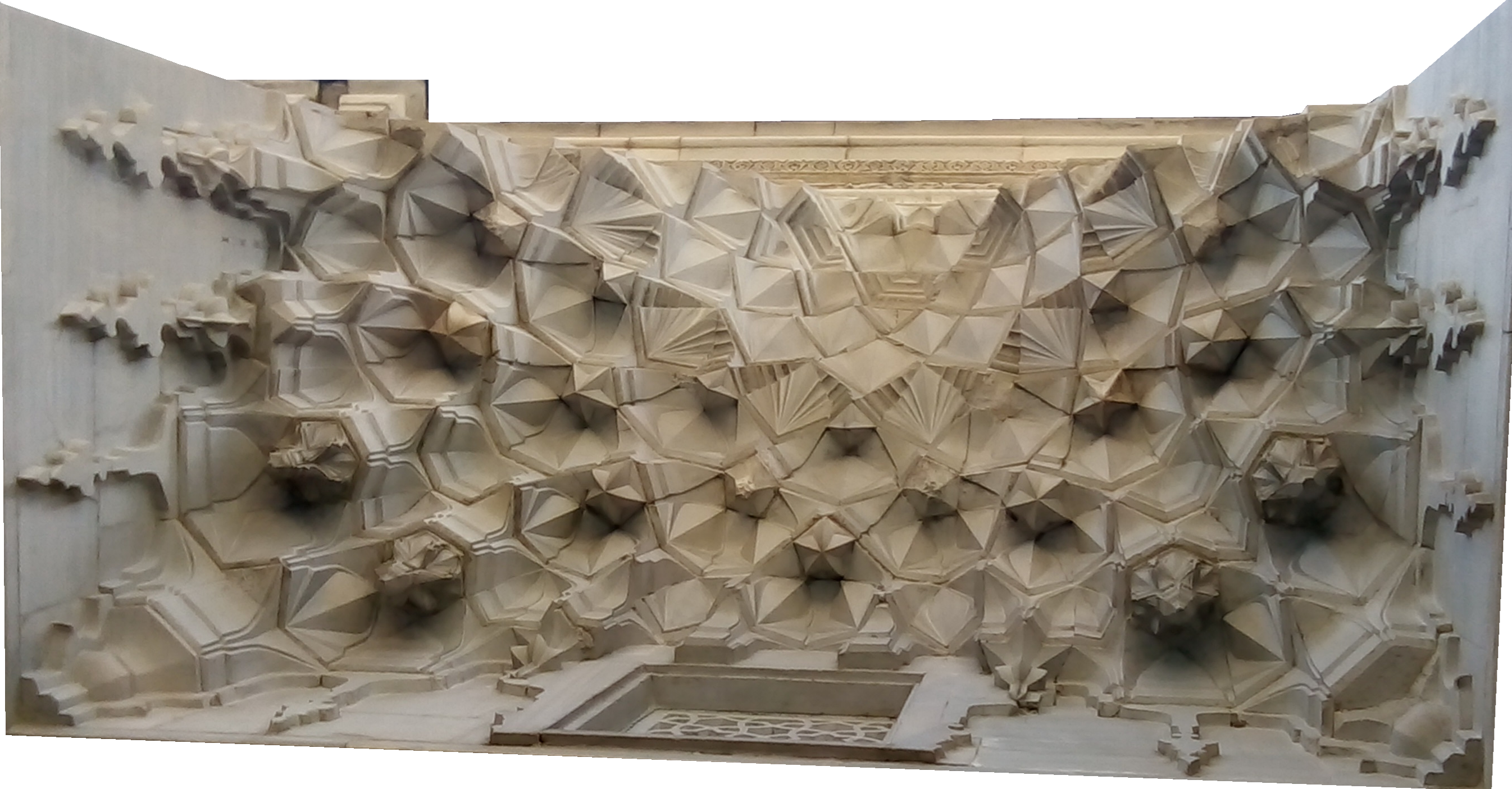
My contribution showcases two muqarnas: one from Isfahan and one from Istanbul. If I had had more space, I would have added more examples, such as those from Kashan,Konya, Kayseri, and Diyarbakir.
Isfahan has been an important city for a millenium. It grew prosperous under the Persian Buyid in the 10th-century. The Turkish founder of the Seljuq dynasty, Toghril Beg, made Isfahan the capital of his domains in the 11th-century; Isfahan regained its importance during the Safavid period. The city's golden age started in 1598 when Abbas the Great chose it as his capital and rebuilt it into one of the largest and most beautiful cities in the world during the 17th-century. The city retains much of its history. I consider myself fortunate to have had the chance to visit Isfahan on two separate occasions.
The Üsküdar Atik Valide Mosque in Istanbul is a 16th-century Ottoman imperial mosque designed by Mimar Sinan. It is located away from the tourist-filled historical centre. Although smaller than the Edirne Selimiye Mosque and the Istanbul Süleymaniye Mosque, it is well worth a visit. I try to visit it every year.
|
Photos on this webpage: |
Related webpages on this website: |
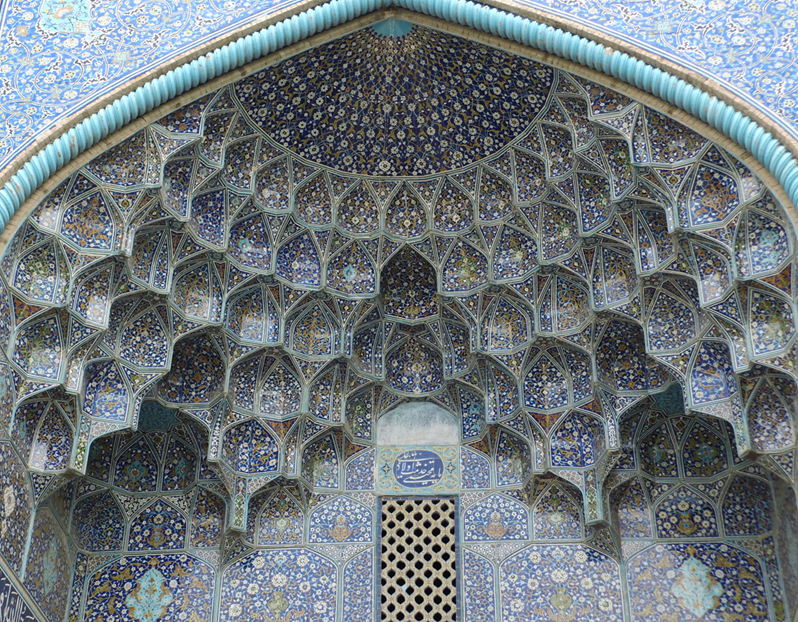

Isfahan Sheikh Lotfollah Mosque
© Henk Hietbrink

Istanbul Üsküdar Atik Valide
© Henk Hietbrink

Istanbul Üsküdar Atik Valide
© Henk Hietbrink

Kashan Agha Bozorg Medresse
© Henk Hietbrink

Konya Sahip Ata Mosque
© Henk Hietbrink
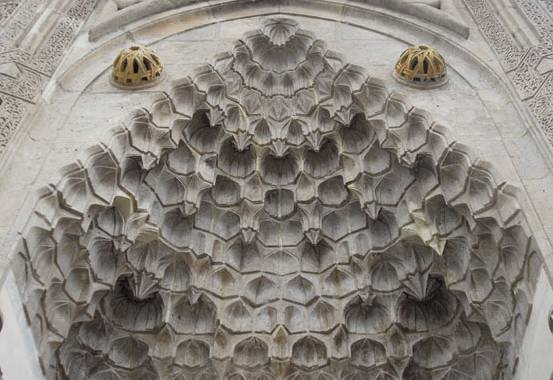
Konya Sahip Ata Mosque
© Henk Hietbrink

Kayseri Gevher Nesibe Hospital
© Henk Hietbrink

Diyarbakır Behram Pasa Mosque
© Henk Hietbrink

Diyarbakır St Mary Church
© Henk Hietbrink

Istanbul ITU Maslak Mosque
© Henk Hietbrink

Istanbul Barbaros Hayrettin Mosque
© Omer Okumus

Istanbul Barbaros Hayrettin Mosque
© Omer Okumus

Figure 2: Examples of muqarnas made of 3D-printed units
Three photos of muqarnas made of 3D-printed Lego-like units are added to my contribution. More examples are on my GeoGebra Muqarnas webpage.
I started with twelve different units, but soon I discovered that I needed many more different types. The basic twelve assume that an upper part (sometimes called a full unit) are always stacked on top of lower units (sometimes called intermediate units). The design of the connectors support this way of stacking. In real life upper parts can be stacked on upper parts too. However the connectors do not support this. As a consequence I had to design variations for each upper part shape to support all possible ways of stacking. In the example of Kayseri Hunat Hatun blue square upper parts are stacked on green rhombus upper parts which in turn are stacked on purple almond upper parts, without any lower part. These additional upper parts have at the top the same connectors as the original lower parts.
|
This webpage: |
Related webpages on this website: |

Small Two Tier Example of 3D Printed Units
© Henk Hietbrink

Small Two Tier Example of 3D Printed Units
© Henk Hietbrink

Small Four Tier Example of 3D printed Units
© Henk Hietbrink

Example of Amasya
© Henk Hietbrink

Two attempts of Kayseri Gevher Nesibe Hospital
© Henk Hietbrink
In these two attempts, the back view (on the right) was made with the original purple almonds. After paying a visit to Kayseri, I learned that the purple shapes are not the correct ones. The front view (on the left) has the proper shapes. Besides, additionl lightblue units were needed. See my Instagram story for more details.
- Kayseri Seljuk museum
The entrance portal of the Kayseri Seljuk museum has interesting building blocks.

Figure 3: From 2D floor plan to 3D printed muqarnas
A gypsum plate discovered at Takht-I Sulayman, possibly depicting a muqarnas plan is mentioned in my contribution because there's ongoing debate about how the central dome may have looked. Another important find was the collapsed remains of the southern vault, and again, scholars hold different views. Given the complexity of the large dome, I chose to highlight these conflicting interpretations . Because of the complexity of the large dome, I chose to first focus on the different proposed solutions for the southern vault. Click on an image for an enlargement.
A separate page goes into more detail, exploring alternative designs for both the Southern Vault and the Central Dome.
|
Figures on this webpage: |
Related webpages on this website: |
Links to literature: |

Muqarnas Takht i Sulayman tesselation and three reconstructions

Muqarnas Takht i Sulayman reconstruction of the Southern Vault


 Open STL file


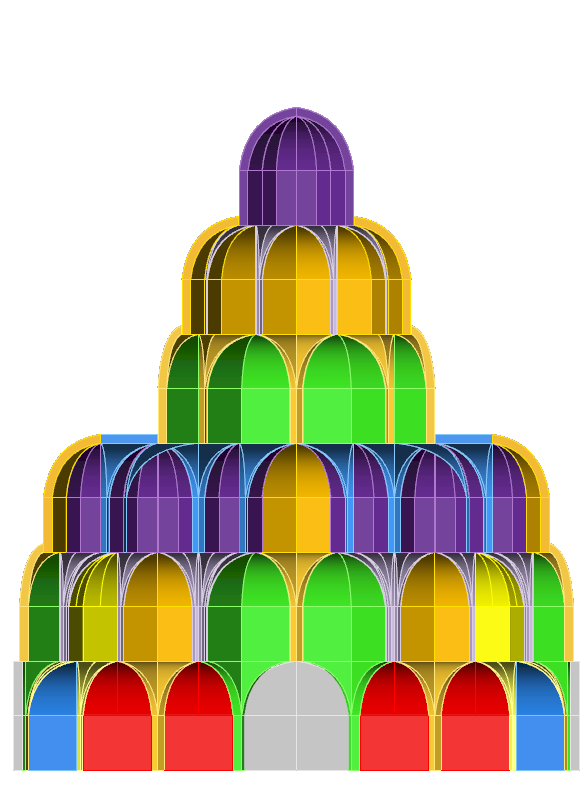


Figure 4: Tables of pre-designed units
My contribution had room for one table. Here are two more. My webpage about units show tables proposed by other authors.
|
This webpage: |
Related webpages on this website: |

Table 1 Pre-designed units; top view and 3D view (including color coding)

Table 2 Additional pre-designed units; top view and 3D view (including color coding)
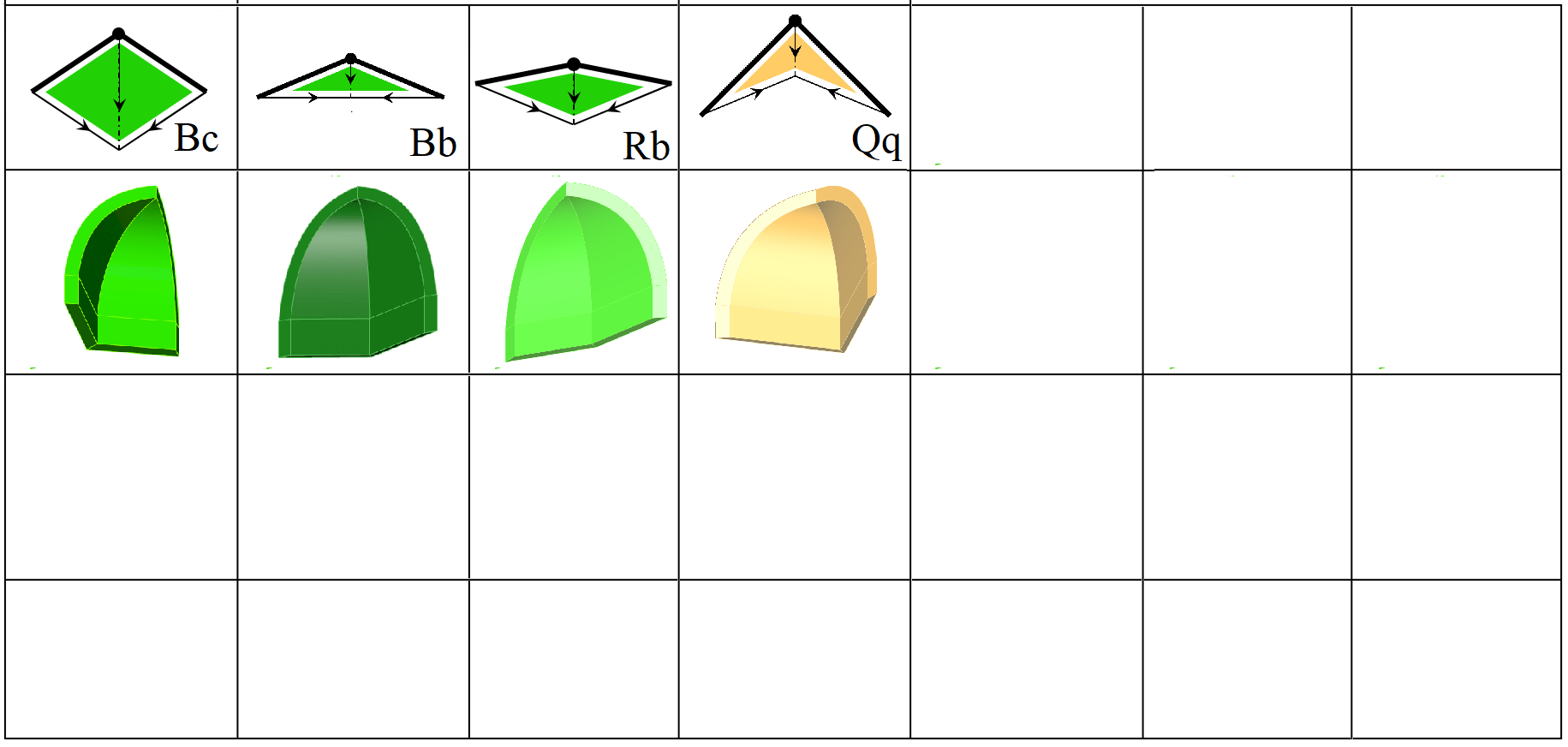
Table 3 Additional pre-designed units; top view and 3D view (including color coding)
Figure 5: Owls eyes
Owls eyes are typical for Ottoman muqarnas, but there is a start in pre_Ottoman times.
|
This webpage: |
Related webpages on this website: | |

Mardin Sultan Isa plan C20 by Ödekan

Mardin Sultan Isa Medresesi
© Dick Osseman

Mardin Sultan Isa Medresesi detail 3D

Mardin Sultan Isa Medresesi in 3D

Kayseri Sultan Han plan C28 by Ödekan

Kayseri Sultan Han Assignment of Units

Kayseri Sultan Han 3D Front View
Pentagons
A section on pentagons was skipped. The photos with pentagons and hexagons in an octagonal grid tell the story. Mathematically, regular pentagons and hexagons cannot fit within such a grid; yet muqarnas defy these rules. Ödekan and Tuncer noted that muqarnas rarely conform to pure octagonal or hexagonal systems. The top may follow a different grid than the base, and in between lie transitional zones.
Before the conquest of Istanbul, Bursa was the capital of the Ottoman Empire. Bursa is known for the Yesil Cami, but the Muradiye Tomb Complex is just as interesting. The tomb complex of Muradiye in Bursa has muqarnas with usually an octagonal grid and irregular pentagons.
Related webpages on this website:
Istanbul Üsküdar Atik Valide
© Henk Hietbrink
Bursa Yesil Cami
© Henk Hietbrink
Bursa Muradiye Tomb Complex
© Henk Hietbrink

Bursa Muradiye Tomb Complex
© Henk Hietbrink

Bursa Muradiye Tomb Complex
© Henk Hietbrink
Figure 6: Yaprak, Kazayagi, Badem, and Fitil
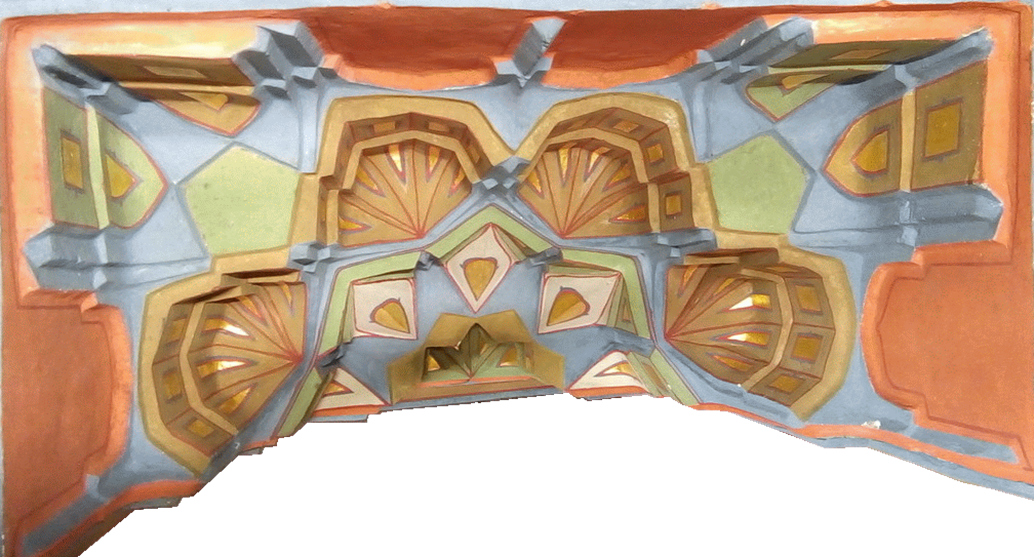
In Anatolian Seljuk muqarnas, the units are classified into three categories: yaprak (upper), kazayagi (base), and püskül, those small hanging ornaments that typically appear at the center of stars. Two additional elements appear in Ottoman muqarnas: fitil, a slimmer version of the kazayagi, and badem, an alternative to the yaprak.

Pre-Ottoman Yaprak on Kazayagi
© Henk Hietbrink

Ottoman Badem on Kazayagi
© Henk Hietbrink

Ottoman Badem on Fitil
© Henk Hietbrink
Figure 7: Diyarbakır Kasim Padisah
One type of irregularity appears when the same shape is used in different sizes; as seen in the mihrab muqarnas of the Kasim Padisah Mosque in Diyarbakır, located above the last congregation mihrab. This muqarnas is built on an octagonal base. The orange jug-shaped unit appears in three different sizes. In the second tier from the top, the jug is reduced to fit onto the purple base unit of the third tier, which features larger-than-normal jugs. In the fourth and sixth tiers, the jug has its regular size.
Diyarbakır Kasim Padisah:

Diyarbakır Kasim Padisah Tuncers Floor Plan

Diyarbakır Kasim Padisah (Assignment of Pre-designed Units

Diyarbakır Kasim Padisah Focus on Enlargements

Diyarbakır Kasim Padisah Exploded 3D Front View
Figure 8: Afyon Cay Tas Medrese
Afyon Cay Tas Medrese is mentioned for its vertical panels.

Afyon Cay Tas Portal Muqarnas with Yaprak, Kazayagi, and Vertical Panels

Afyon Cay Tas Floor Plan by Ödekan

Afyon Cay Tas Assignment of Pre-designed Units

Exploded Front View in Rhino / Grasshopper with my Assignment Including Vertical Units.
Figure 9: Marmara University Theology Faculty Mosque
The Marmara University Theology Faculty Mosque is mentioned because it features rare units T and U.
|
Marmara University |
Akseray Sultan Han |
Mardin Sultan Isa |
Marmara University Theology Faculty Mosque mihrab

Marmara University Theology Faculty Mosque mihrab
© Henk Hietbrink

Marmara University Theology Faculty Mosque assignment of Pre-designed units

Marmara University Theology Faculty Mosque detail of 3D frontview

Marmara University Theology Faculty Mosque exploded 3D frontview
C04 Sultanhan - on the Nigde Akseray Road: Portal Muqarnas (front)

Akseray Sultan Han portal muqarnas
© Henk Hietbrink

Akseray Sultan Han portal muqarnas detail
© Henk Hietbrink

Akseray Sultan Han portal floor plan
© Ödekan

Akseray Sultan Han 3D frontview Rhino / Grasshopper
Mardin Sultan Isa

Mardin Sultan Isa detail
© Henk Hietbrink

Mardin Sultan Isa floor plan
© Tuncer